
Living Labs
Signal Lab
Signal Lab has long focused on the research and development of advanced signal processing methods, with an emphasis on their practical implementation in technical and biomedical applications. The laboratory’s research activities are systematically built upon a continuous line of projects that gradually expands both the methodological foundation and the range of applications for the tasks being addressed.
Signal Lab thus represents an interdisciplinary research center connecting the fields of signal processing, artificial intelligence, optimization methods, and applied engineering. The laboratory’s outputs have the potential for direct application in industry, energy, autonomous systems, and medical technologies.
Industry
Services & Equipment
The lab focuses on advanced AI and sensing technologies for healthcare and biomedical applications. It supports research and innovation in smarter diagnostics, patient monitoring, and precision medicine.
Our cooperation includes:
A new era in sleep apnea diagnostics
Together with experts from the University of Texas at Arlington, we are working on the development of sophisticated methods of sleep apnea diagnosis and severity level estimation.
Advanced neonatal care powered by Artificial Intelligence
We build AI-based monitoring tools for neonatal care, including for infants with HIE. Advanced signal processing techniques eliminate motion artifacts, providing clearer and more accurate real-time data.
Innovative fetal monitoring for safer pregnancies
Patented fetal ECG technologies, as well as a proprietary simulation platform, are driving innovation in fetal monitoring for a safer, more reliable experience for expectant mothers. Our research is leading to the early detection of fetal heart abnormalities, giving mothers peace of mind.
Modern technologies for precision veterinary medicine
We, in collaboration with animal healthcare specialists in Brno, are developing smart sensing technology for precise monitoring of vital parameters and cardiac activity in animals. Intelligent algorithms assist in minimizing motion artifacts.
Radiology expertise and AI-driven clinical decision support
We leverage large-scale medical imaging datasets to develop advanced CAD and CADx tools across neurology, oncology, gynecology, urology, and musculoskeletal imaging. Our solutions enhance diagnostic accuracy, support clinical workflows, and enable data-driven decision-making in radiology.
Smart sensor system for MRI examinations
Our patented system is capable of monitoring cardiorespiratory activities in patients during MRI examinations even in harsh electromagnetic environments. This makes MRI examinations more efficient and comfortable for patients.
Space medicine and the IKAROS project
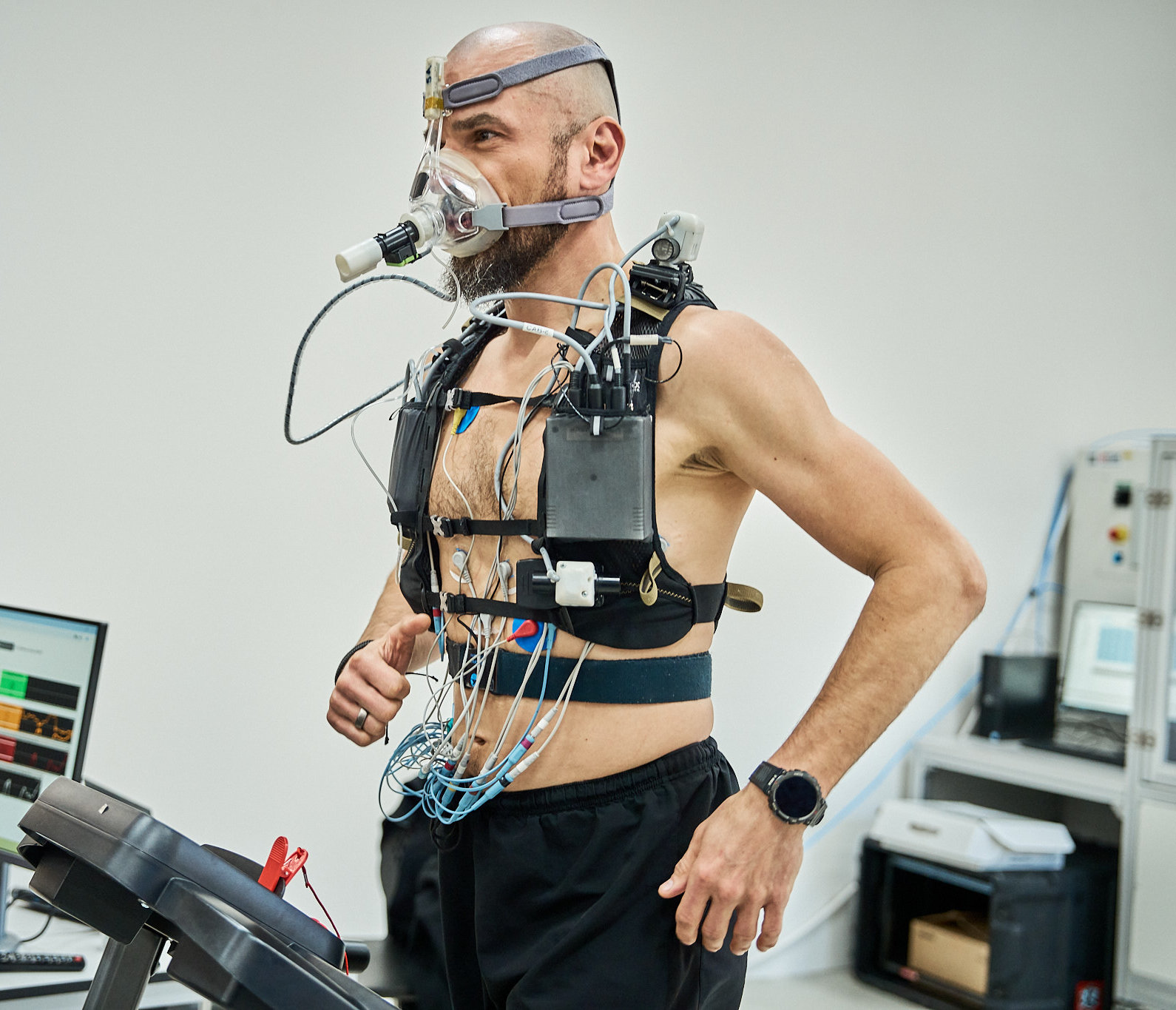
The research area of cardiovascular and respiratory adaptation in extreme environments using intelligent garments and pneumatic ballistocardiography can be used for both space missions and clinical cardiology.
Synthetic data, foundation models, and scalable AI infrastructure
We develop diffusion-based synthetic data generation pipelines and AI models for diagnosis classification from medical documentation. Our expertise spans edge computing, federated learning, and foundation models, supported by scalable infrastructure ranging from high-performance workstations (including multi-GPU setups such as NVIDIA RTX 6000 Ada Generation GPU systems and NVIDIA DGX systems) to edge AI deployments.
Equipment & facilities
Acoustic cameras
Used within the lab’s signal processing and intelligent sensing workflows for experimental diagnostics and monitoring.
Ettus USRP X410 software-defined radio
Supports advanced signal processing, communication experiments, and prototyping of applied engineering scenarios.
Hyperspectral cameras
Applicable to advanced imaging workflows across medical, technical, and AI-assisted diagnostic scenarios.
National Instruments measurement portfolio
Supports laboratory prototyping and research workflows across intelligent sensing, instrumentation, and applied engineering.
VibroGo laser vibrometer
Suitable for precise experimental diagnostics in advanced signal processing and applied engineering tasks.
Projects

AI-controlled roll straightening systems & processes
CONREX – Czech Orbital NanoRobots Experiment
PROTECT – Perinatal Research for Optimal Treatment and Enhanced Clinical Technology
Research and development of machine vision technology with artificial intelligence for the production of hydrogen pressure vessels
TOP Publications